
**** Pre-Investment ****
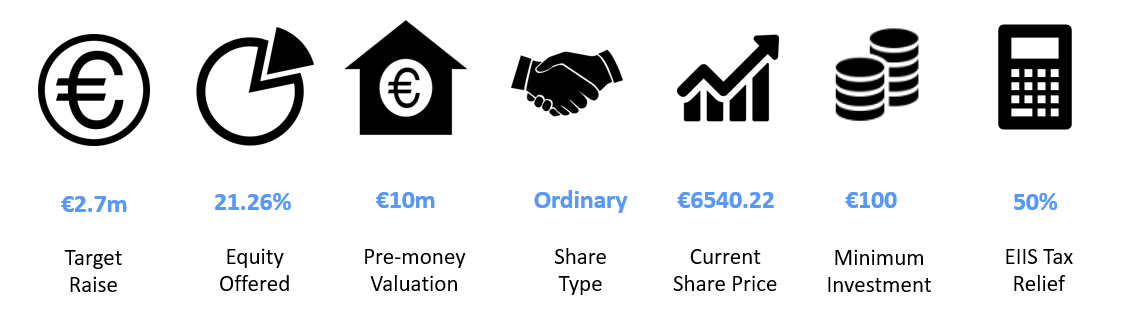
There is a sum of €2.5m that is indicated on the status bar that is being invested through third parties in this round.
€1.5m from VC - Castanjo Ventures
€500k from VC - NLC Health Ventures (follow-on investment)
€500k from Enterprise Ireland
Business Model
The product is not yet generating revenues and is progressing through the final stages of pre-clinical and regulatory readiness before entering human trials.
Products and Services
Altach Biomedical is developing CartiFix, the first tissue-specific, Type-II collagen–based regenerative implant for repairing cartilage and osteochondral defects. CartiFix uses a bi-layered extracellular matrix (ECM) scaffold derived directly from articular cartilage (rich in Type-II collagen) and bone ECM, enabling true biological regeneration in a single-stage, minimally invasive procedure.
Problem Solved
Cartilage has almost no capacity to heal. Current treatment options—microfracture, debridement, injections, and Type-I collagen scaffolds—offer only temporary relief and typically lead to inferior fibrocartilage formation. This tissue lacks the structure and durability of hyaline cartilage, often resulting in pain, deterioration, and ultimately joint replacement. This gap affects millions of active adults and early osteoarthritis patients who are too young for implants but still symptomatic.
What makes the Altach solution unique:
CartiFix is the only regenerative scaffold made from Type-II collagen, the same collagen that forms native articular cartilage. This gives the scaffold biological cues that Type-I collagen products simply cannot provide. Type-II collagen naturally promotes chondrocyte activity, reduces inflammatory signalling, supports hyaline cartilage formation, and works with the body’s immune system to guide true tissue regeneration.
Because the scaffold is tissue-specific, it provides:
• Superior chondro-inductivity
• Restoration of native-like hyaline cartilage
• Better mechanical compatibility
• Reduced inflammatory response
• Improved long-term repair potential
Who is Altach solving it for:
• Orthopaedic surgeons treating focal chondral or osteochondral defects
• Patients aged 18–65 with cartilage injuries or early osteoarthritis
• Healthcare systems seeking durable, regenerative alternatives to delay or avoid joint replacement
CartiFix offers an off-the-shelf, arthroscopic implant that regenerates the right tissue in the right way—because it is built from the same biological material as the tissue it aims to restore.
Current Traction
• Company is in pre-revenue mode.
• Installation of Cleanroom in Galway lab and beginning of in house ECM manufacturing.
• Core Patents (granted and published):
• EP3180043A1 / US20170232144A1
• “A method for making a porous scaffold suitable for use in repair of osseous, chondral or osteochondral defects.” Covers the scaffold fabrication process, ECM handling, structural characteristics, and core biomaterial composition.
Partnerships
1. Significant progress in manufacturing scale-up, including validated ECM isolation processes (HCM Medical, Ireland) and freeze-drying optimisation with BioPharma Process Systems (UK).
2. Early prototype instruments and delivery devices developed with BAAT Medical (Netherlands), validated through hands-on surgeon evaluations at international congresses.
3. Product characterisation and regulatory workstreams underway with Intertek France, Eurofins, Bruder Consulting (US) and Key2Compliance (EU).
4. Large-animal feasibility and GLP study preparation in collaboration with Veranex (Paris).
USP
CartiFix is the first cartilage repair implant built from tissue-specific, Type-II collagen–rich extracellular matrix, derived directly from articular cartilage. This is fundamentally different from current scaffolds, which are almost all Type-I collagen and lack the biological signals needed to regenerate true hyaline cartilage. Our material provides the same biochemical cues found in native cartilage, guiding the body’s own cells toward genuine tissue regeneration.
The scaffold is fabricated as a bi-layer structure, with a cartilage-specific top layer and a bone-specific lower layer, replicating the natural organisation of the osteochondral unit. This architecture, supported by extensive published data and large-animal studies, enables organised tissue formation that closely resembles native cartilage and subchondral bone—something competitors have not been able to achieve.
A second unique aspect is the scaffold’s elastic, shape-adaptive mechanical behaviour. It compresses without damage and expands to fit securely into the defect, allowing implantation arthroscopically through a narrow portal. This eliminates the need for sutures, glue, or fixation devices and enables immediate post-operative weight-bearing, which is not possible with current scaffold technologies.
The technology also works without the need for exogenous cells or two-stage procedures. Surgeons can perform a single, minimally invasive operation, with the option to hydrate the scaffold with PRP or BMAC if desired. This simplifies workflow, reduces cost, and dramatically increases accessibility.
These innovations are protected by a granted international patent, exclusive and perpetual licence rights, and more than a decade of proprietary know-how in ECM isolation, crosslinking chemistry, freeze-drying optimisation, and pore architecture control. No other company currently possesses a Type-II collagen scaffold manufactured through this process, nor the underlying scientific foundation demonstrated across the preclinical evidence.
In combination, the tissue specificity, biological performance, mechanical behaviour, simplicity of use, and protected know-how make CartiFix a truly first-in-class regenerative solution in the global cartilage repair market.
Competitors
Type-I collagen scaffolds (e.g., Chondro-Gide, MaioRegen, Chondrofix)
These products provide structural support but lack the biological cues needed to regenerate true hyaline cartilage. Clinical results often show fibrocartilage formation, variable durability, and limited long-term outcomes.
Cell-based therapies (e.g., MACI, ACI variants, stem-cell–based injections)
These require two-stage procedures, are expensive, logistically complex, and often fail to produce tissue with native cartilage architecture. Adoption is declining due to cost and clinical variability.
Osteochondral allografts/autografts (OATS, mosaicplasty)
While effective for some cases, these are limited by donor tissue availability, morbidity at the harvest site, inconsistent integration, and a high barrier to scale.
Market size to be addressed
Accessible Market
The global cartilage repair market is large and expanding. It was valued at ~USD 4.5 billion in 2020 and is projected to grow at a ~5.8% CAGR through 2027, driven by rising rates of osteoarthritis, sports injuries, and the growing demand for joint-preserving treatments. Over 250 million people worldwide are currently affected by osteoarthritis, creating sustained clinical and economic pressure for better early-stage interventions.
Where the market is
• North America – the largest and fastest-adopting region, benefiting from advanced healthcare infrastructure, strong reimbursement, and high surgeon demand for effective regenerative treatments.
• Europe – a major second pillar, with a rapidly ageing population, increasing OA prevalence, and a strong focus on minimally invasive joint-preservation procedures.
• Asia-Pacific – the next high-growth region, driven by expanding healthcare investment, rising incomes, and a surge in sports-related injuries.
Past Funding Details
• €1.5 m raised to date. (Spark Venture, Enterprise Ireland, NLC and private investors)
• €2.5 m target for this raise (Spark Venture, Castanjo, NLC)
Expansion and Growth Plans
Altach’s primary strategic objective over the next five years is to bring CartiFix to pivotal clinical evaluation and position the company for regulatory approval in both the EU and the US.
By 2028, Altach plans to initiate a pivotal PMA-enabling clinical trial, conducted across leading centres in Europe and the United States, with a two-year follow-up period. This study will generate the high-quality safety and efficacy data required for PMA submission in the US and MDR regulatory approval in Europe.
To reach this milestone, the focus for the next 3–5 years includes:
• Completing all remaining verification, validation, and process development activities
• Executing feasibility and GLP large-animal studies with Veranex
• Finalising clinical-grade manufacturing scale-up with HCM Medical and BioPharma
• Building out regulatory, quality, and clinical infrastructure to support international trials
• Securing strategic partnerships with leading orthopaedic centres and industry stakeholders
Justification of company valuation
• Peer group analysis of orthopaedic implant market valuations.
• Investment in the product/innovation to date
• IP patent protection
• Significant progress and de-risking of project with the following milestones already achieved:
• Establishing a reproducible ECM manufacturing process with HCM Medical
• Transitioning freeze-drying optimisation and scale-up to BioPharma (UK)
• Implementing a full ISO 13485-compliant eQMS via BAAT
• Completing first-generation surgical tools and delivery device prototypes
• Initiating FDA Pre-RFD planning and EU MDR regulatory mapping
• Preparing feasibility and GLP large-animal studies with Veranex (Paris)